
The Microbiome: What We Know, What We Don’t, and Why the Headlines Often Go Too Far
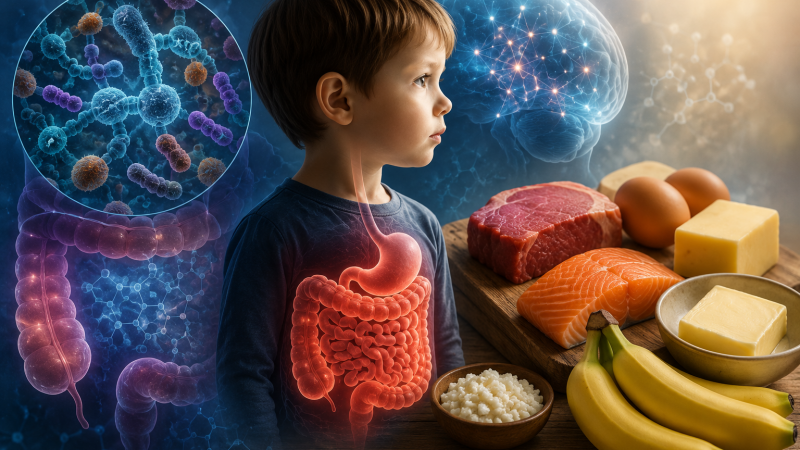
Every few weeks a new headline appears telling us that a particular diet creates a “healthier microbiome.”
Recently, the Mediterranean diet was reported to be associated with a more favorable gut microbiome. Similar claims have been made about vegan diets, high-fiber diets, fermented foods, probiotics, and countless supplements.
The impression given is often that the science is settled.
It isn’t.
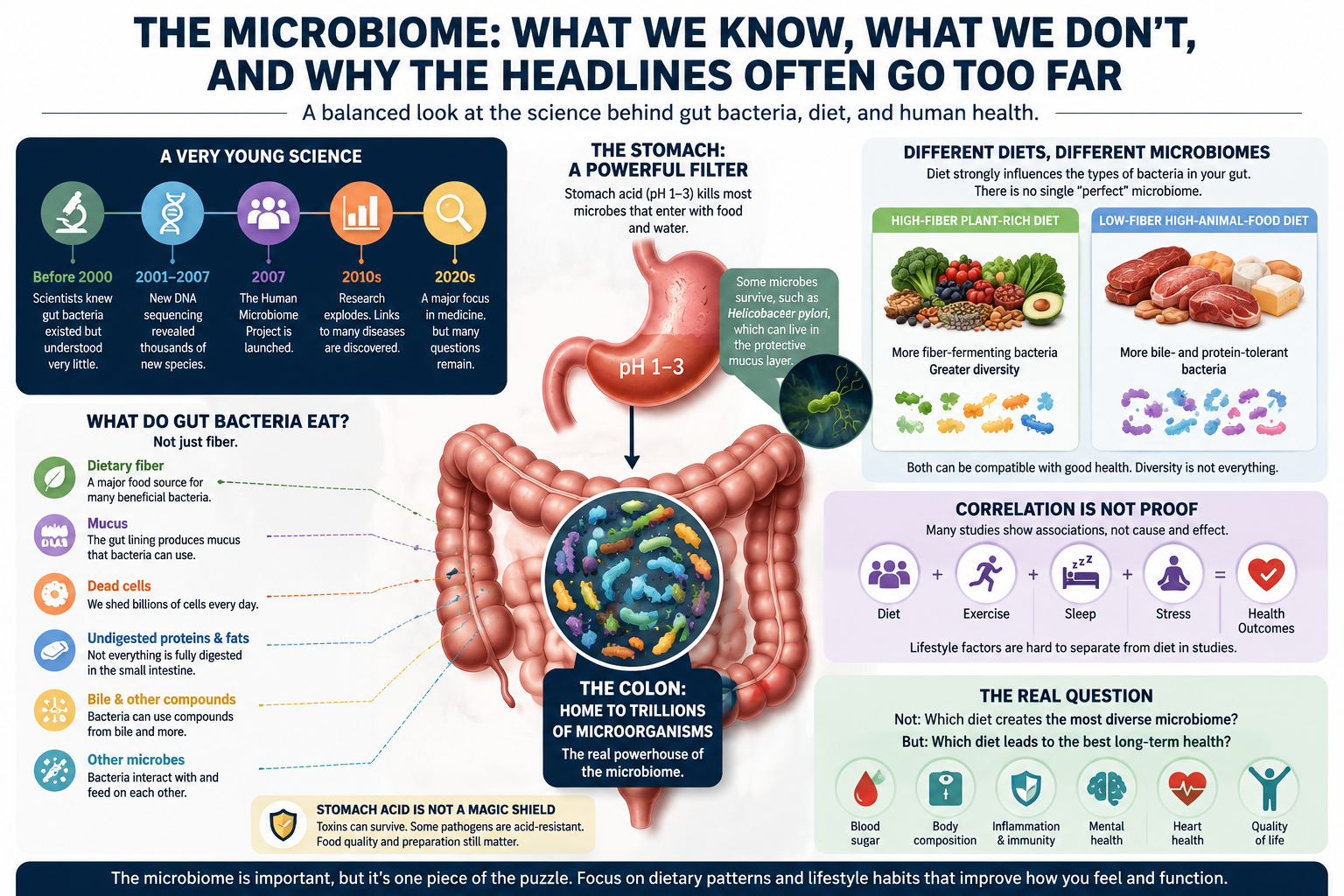
A Very Young Science
The human gut contains trillions of microorganisms. Scientists have known about bacteria for more than a century, but the modern microbiome era is surprisingly recent.
For most of medical history, researchers could only study bacteria that could be grown in a laboratory. The majority of gut bacteria could not be cultured, leaving much of the microbial world hidden from view.
Everything changed with modern DNA sequencing.
The Human Microbiome Project was launched in 2007, and only during the last fifteen to twenty years has microbiome research exploded. Thousands of studies have linked gut bacteria to obesity, diabetes, inflammatory bowel disease, immunity, mental health, and many other conditions.
This is exciting science, but it is still young science.
The Stomach Is Not a Friendly Place
One fact often overlooked in discussions about the microbiome is that the human digestive system is designed to destroy microbes.
The stomach contains hydrochloric acid with a pH that can fall to around 1 to 2 when empty. This is one of the most acidic environments found in the animal kingdom.
For decades, scientists believed the stomach was essentially sterile.
We now know that some microorganisms survive, but most do not. The stomach acts as a powerful filter, killing many bacteria before they ever reach the intestines.
This raises an important question:
If stomach acid destroys so many microbes, where does the microbiome come from?
Does the Microbiome Come From Fiber?
The popular answer is simple:
“Fiber feeds the microbiome.”
There is truth in this statement.
Humans cannot digest many forms of dietary fiber. These fibers pass into the large intestine where bacteria ferment them and produce compounds known as short-chain fatty acids.
However, the story is more complicated.
Gut bacteria do not survive solely on plant fiber.
They also consume:
- Mucus produced by the intestinal lining
- Dead intestinal cells
- Undigested proteins
- Undigested fats
- Bile compounds
- Other microorganisms
Even a person eating no fiber would still possess a microbiome. The composition would change, but the microbes would not disappear.
The human body continuously supplies nutrients that bacteria can use.
A Different Microbiome Is Not Necessarily A Bad Microbiome
Many studies show that people eating high-fiber diets tend to have greater microbial diversity.
This finding is often interpreted as evidence that higher diversity automatically means better health.
The reality is not so clear.
Scientists still cannot define a single “ideal” microbiome.
Healthy populations around the world often possess very different microbial communities. A person eating a Mediterranean diet may have a different microbiome from someone eating a traditional Inuit diet, yet both may be healthy.
Diet changes the microbiome.
That much is clear.
Whether one microbiome is universally superior to another is far less certain.
Correlation Is Not Proof
A major weakness in many microbiome studies is that they are observational.
People who follow Mediterranean diets often exercise more, smoke less, sleep better, and engage in other health-conscious behaviors.
Researchers attempt to adjust for these factors, but separating the effects of diet from lifestyle is difficult.
Finding a correlation between a dietary pattern and a microbial pattern does not prove that one causes the other or that either directly causes better health.
The Real Question
The question should not be:
“Which diet creates the most diverse microbiome?”
The question should be:
“Which diet produces the best long-term health outcomes?”
These are not necessarily the same thing.
The microbiome is one piece of human biology. It is not the entire picture.
Blood sugar control, body composition, inflammation, mental health, autoimmune symptoms, cardiovascular risk, and quality of life matter too.
A diet should ultimately be judged by its effects on people, not merely by the species of bacteria found in a stool sample.
Conclusion
The microbiome is one of the most fascinating areas of modern medicine. It is also one of the most misunderstood.
The science is advancing rapidly, but many questions remain unanswered.
Fiber undoubtedly feeds certain bacteria. Yet gut microbes also rely on nutrients supplied by the body itself. Different diets create different microbial environments, and scientists still do not know exactly what the optimal microbiome looks like.
When you see headlines claiming that a particular diet creates a “better microbiome,” remember that the field is still young, the evidence is often preliminary, and the most important outcome is not what happens in a petri dish or sequencing machine.
It is what happens to human health.