
The Fracture Point
Analysis & Commentary · United Kingdom
How a government in freefall, a burning street in Belfast, and a generation locked out of a normal life all point to the same crisis.
London
Analysis
Keir Starmer is the sixth British Prime Minister in ten years. If his internal critics succeed, his successor will be the seventh. But the revolving door at Downing Street is not the disease — it is a symptom. The country beneath it is fracturing along fault lines that predate any individual leader.
On the morning of 14 May 2026, Health Secretary Wes Streeting posted his resignation letter to social media. It was the most damaging single act of open rebellion that Starmer’s government had yet faced — and it had been building for months. By then, over 95 Labour MPs had publicly called on the Prime Minister to resign or set out a timetable for his departure. Four junior ministers had already quit. Angela Rayner, cleared that same day of a tax scandal that had forced her from the Cabinet the previous September, immediately signalled she was ready to stand in any leadership contest.
Meanwhile, in Greater Manchester, a sitting MP named Josh Simons resigned his own seat to create a parliamentary route for Andy Burnham — currently the region’s mayor and, according to polling, the most popular of the likely leadership candidates — to re-enter the Commons. The dominoes were falling in sequence.
The collapse in numbers
Labour’s poll ratings tell a stark story. A YouGov survey published in January 2026 found the party at just 17 per cent — third place, behind Reform on 26 per cent and the Conservatives on 19 per cent, barely above the Greens on 15. By May, the local, Scottish Parliament, and Senedd elections confirmed that trajectory. Reform made sweeping gains across English councils. The Greens overturned safe Labour majorities in Greater Manchester. In Runcorn and Helsby, Labour lost a seat it had held comfortably since 1997.
The leadership crisis in sequence
February 2026
Scottish Labour leader Anas Sarwar publicly calls for Starmer to resign — one of the first senior Labour figures to do so.
May 7, 2026
Local, Scottish Parliament, and Senedd elections produce catastrophic results for Labour. The formal leadership crisis begins.
May 11, 2026
Starmer holds what the Guardian describes as a “final chance” press conference. Angela Rayner tells the party he should “reflect on his position.”
May 14, 2026
Wes Streeting resigns as Health Secretary, declaring it would be “dishonourable and unprincipled” to remain. He confirms he will stand if a contest is triggered.
May 14–present
Josh Simons resigns his seat to clear a path for Andy Burnham. Over 95 Labour MPs have now called for Starmer’s departure.
The rebels require 81 Labour MPs — a fifth of the parliamentary party — to formally trigger a leadership contest under party rules. They have already passed that threshold in stated intent. What remains is coordination, and the absence of an obvious single challenger around whom the party can unite.
The likely field
Three figures dominate speculation about what comes next, each embodying a different answer to the same question: what went wrong, and who can fix it?
Wes Streeting
Former Health Secretary
From Labour’s Blairite right. Long-harboured leadership ambitions. His resignation triggered the crisis but also made him a polarising figure — reportedly unpopular with party members who favour Burnham.
Centre-right
Angela Rayner
Former Deputy PM
Cleared of tax irregularities on the same day Streeting resigned. Has been sharpening her critique from outside Cabinet since September 2025. Popular with trade union-aligned members.
Centre-left
Andy Burnham
Mayor of Greater Manchester
The most poll-favoured candidate. Has built a grassroots reputation outside Westminster. Must win a by-election to re-enter Parliament — a process the NEC previously blocked in February.
Regional
The internal party base that would elect a new leader has grown markedly more left-wing since Starmer’s 2024 election victory. A successor who skews left on public ownership, migration policy, and wealth taxation is plausible — representing not a considered national mandate, but a reaction against what many members perceive as the betrayal of the 2024 promise.
“Where we need vision, we have a vacuum.”
Wes Streeting, resignation letter, 14 May 2026
The streets of Belfast and Southampton
While Westminster consumed itself, something uglier was taking shape on the ground. On the evening of 9 June 2026, riots broke out across Belfast after a Sudanese man stabbed a local resident the night before. By the early hours, houses, cars and at least one bus had been set alight. Masked men were filmed kicking in doors on the Lower Newtownards Road, claiming to be “getting the foreigners out.” A Middle Eastern supermarket was destroyed. Protests rippled outward — to Antrim, Bangor, Ballymena, and as far as Glasgow, Edinburgh, and Southampton in England.
Southampton had already been burning. The previous week, the sentencing of Vickrum Digwa — a British Sikh man given a minimum 21-year term for the murder of 18-year-old Henry Nowak in December 2025 — had produced violent clashes with police. Digwa had falsely claimed to officers that he was the victim of a racist attack; body-camera footage showed officers placing Nowak in handcuffs as he lay dying. Protesters stood outside a Southampton hotel housing asylum seekers, though both the victim and the killer were British. The case had drawn international attention, with commentary from Elon Musk among others.
The victim’s own father issued a public statement asking that his son’s death not be used to create “further division, hatred or tension.” The Sikh community reported a surge of racial and verbal abuse in the aftermath. None of it stopped the disorder spreading.
This is the pattern that has now repeated itself several times across the United Kingdom — from the Southport riots of July 2024 to Ballymena in June 2025 to this week. An act of violence, often horrifying in its specifics, ignites pre-existing tensions. The facts of each individual case are rapidly displaced by online amplification, political opportunism, and long-accumulated rage directed at the nearest available target.
The deeper disorder
To frame what is happening as simply an immigration debate, or as far-right agitation, or as political crisis is to mistake a symptom for its cause. All three are true, and none of them is sufficient.
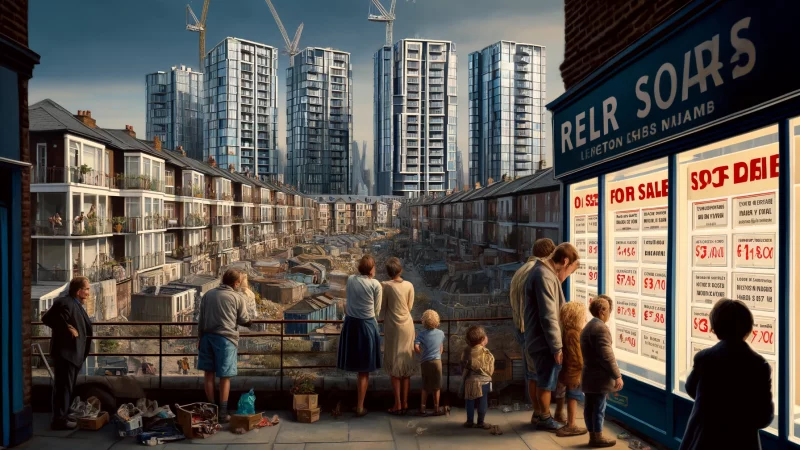
What the riots, the leadership rebellion, and the polling share is a common substrate: an electorate that has concluded, across class lines and party allegiances, that the governing order is fundamentally indifferent to its circumstances. This is not merely economic grievance, though the erosion of affordable housing, stagnant real wages, and the disappearance of stable employment for non-graduate workers are all real and documented. It is something closer to a collapse of legitimacy.
The Western middle-class compact — the understanding that participation, tax payment, and rule-following would yield a stable, self-sufficient life — has visibly broken down for millions of people in the United Kingdom over the past two decades. When that promise fails, the question of who is to blame becomes urgent, and the answers that gain traction are rarely measured ones.
Decades of underinvestment in public infrastructure have left local services — from community health to policing to social housing allocation — operating at or beyond capacity. When public resources are genuinely scarce, communities do not abstractly discuss policy trade-offs. They compete. And competition, when it occurs between communities that already do not share a strong sense of common culture or trust in shared institutions, can turn violent with minimal provocation.
Overlaid on this is a perception — not entirely invented — that the state applies its rules with inconsistency. The Southampton case brought this into sharp relief: police footage suggesting that officers gave weight to an allegation of racism before establishing whether the alleged victim was dying on the pavement is, regardless of the full context, the kind of detail that confirms an existing narrative for millions of people. That narrative is one of a two-tier justice system. Once that belief takes hold, it is almost impossible to dislodge by official reassurance alone.
What a change at the top will not fix
There will, in all probability, be a new Labour leader within six to twelve months. The parliamentary arithmetic and the psychological momentum of the current crisis make Starmer’s position extremely difficult to sustain. Whether that new leader is Burnham, Rayner, Streeting, or someone not yet in the reckoning, they will inherit a Britain whose problems are structural, deep, and not amenable to the kind of managed incrementalism that has defined Labour’s approach since 2024.
The riots will be attributed to far-right agitators — and some of the organisation behind them does originate in those networks. The political instability will be attributed to Starmer’s personal failings — and he has, genuinely, made strategic errors. But neither explanation accounts for why the kindling is so dry. A country in which housing is inaccessible, public services are overstretched, trust in institutions is exhausted, and the governing class is perceived as sealed off from ordinary experience is a country in which almost any spark can start a fire.
The succession drama in Westminster may produce a new face. The structural conditions that make the United Kingdom so combustible right now will not change with the nameplate on the door of Number Ten.