China’s AI Infrastructure Surges: Inside the Massive Data Center Expansion Rivaling Global Giants
China’s AI Infrastructure Surges: Inside the Massive Data Center Expansion Rivaling Global Giants
SHANGHAI — While international policy debates focus heavily on semiconductor export controls, a sweeping infrastructure transformation is unfolding across China. Backed by rapid modular construction techniques and massive government-backed initiatives, the country is quickly scaling up an expansive network of AI data center campuses designed to fuel the next generation of domestic artificial intelligence.
The 30 GW Data Center Buildout Reshaping the Global AI Landscape
Current estimates place China’s data center fleet at over 30 GW across more than 1,000 facilities, with an additional 20 GW currently moving through the development pipeline. Utilizing modular pre-assembly for electrical and cooling systems, developers are able to bring massive 100-megawatt data center facilities online in under a year, a construction velocity that outpaces many Western equivalents.
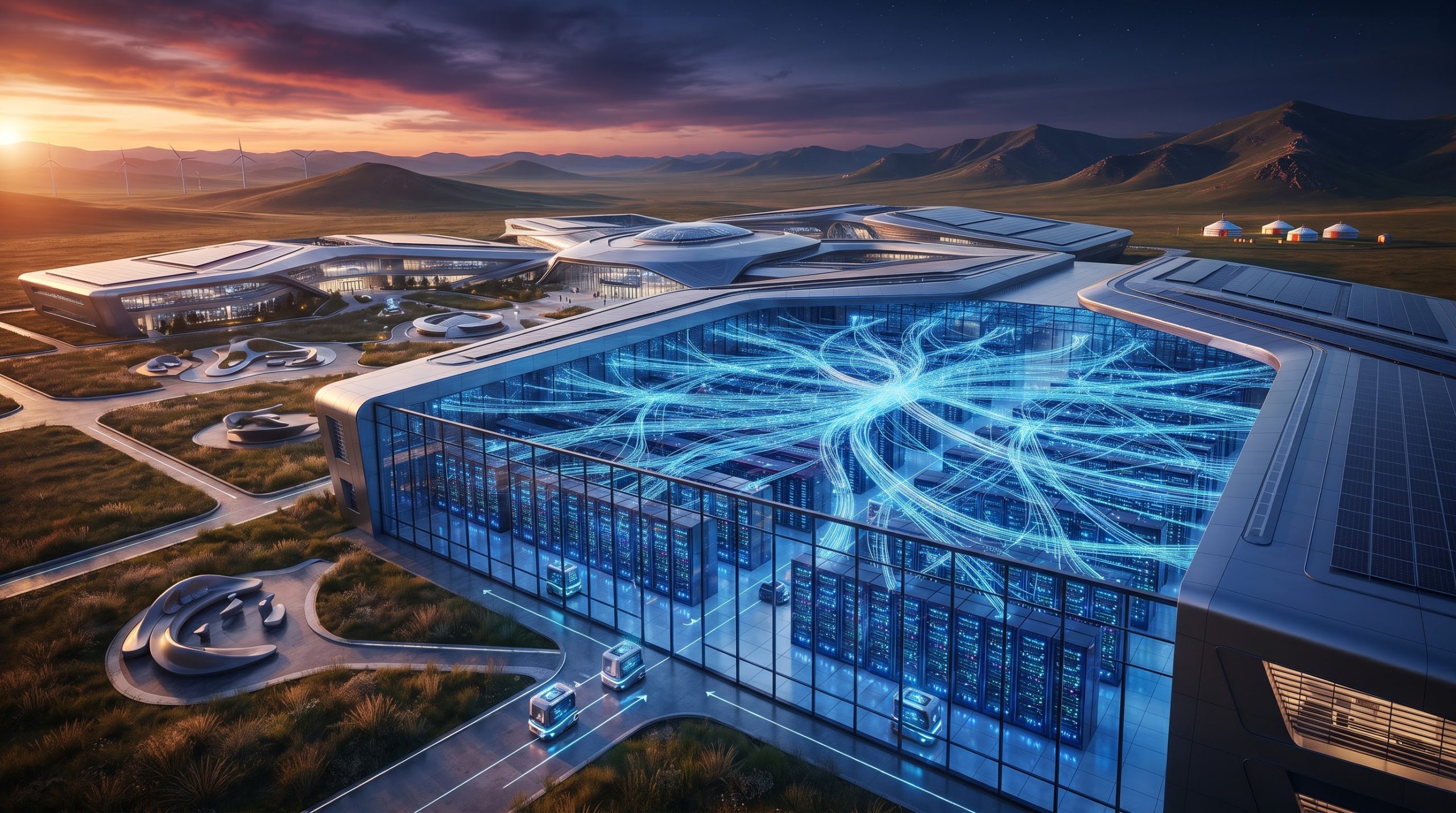
To mitigate urban power and space limitations in major coastal hubs like Beijing, Shanghai, and Shenzhen, energy-intensive AI training workloads are being redirected under the “Eastern Data Western Compute” strategy to cooler, power-abundant regions in China’s west and northwest. A prime example of this decentralized approach is unfolding in Inner Mongolia. In hubs like Ulanqab—where the annual average temperature hovers around a cool 4°C (39°F)—massive computing campuses are taking shape to leverage natural climate cooling and significantly lower electricity costs. With local access to abundant wind, solar, and conventional power generation, data centers operating in these northern hubs can secure energy at roughly half the cost of major metropolitan centers, making round-the-clock AI model training economically viable at scale.
Inside Huawei’s Optical Breakthroughs and China’s Race for Domestic Computing Independence
To power these expansive facilities despite ongoing restrictions on advanced foreign graphics processing units, domestic tech firms are scaling up homegrown alternatives. Huawei has emerged as a central pillar of this ecosystem, deploying large “Super Pod” architectures that link thousands of Ascend neural processing units together. To combat the massive communication bottlenecks and thermal loads typical of large GPU clusters, recent deployments are increasingly incorporating Near-Packaged Optics. By placing optical engines close to the electronic chips, data is rapidly converted into light and transmitted across optical fibers—slashing communication power consumption by over 550 kilowatts per Super Pod and preventing expensive processors from sitting idle while waiting for data.
Alongside hardware advancements, software ecosystems are evolving. Open-source programming languages like Tile Language are enabling developers to write code that runs efficiently across both legacy architectures and domestic chips, gradually lowering barriers outside traditional proprietary software environments. While domestic foundries like SMIC continue pushing production capacity near their limits—and work intensely to overcome supply hurdles surrounding High Bandwidth Memory and advanced lithography—the sheer velocity of China’s data center construction points toward a heavily industrialized future for AI. With major tech companies like ByteDance, Alibaba, and Tencent driving demand for large-scale model training and inference, the infrastructure being laid today will profoundly shape the availability and performance of AI tools worldwide.